Badge
AI Agents for HR: The Strategic Guide to Automating the Employee Lifecycle
Discover how Agentic AI is transforming HR in 2026. Learn from the Starbucks case study on how to cut hiring time by 75% and reduce turnover using autonomous recruitment agents.
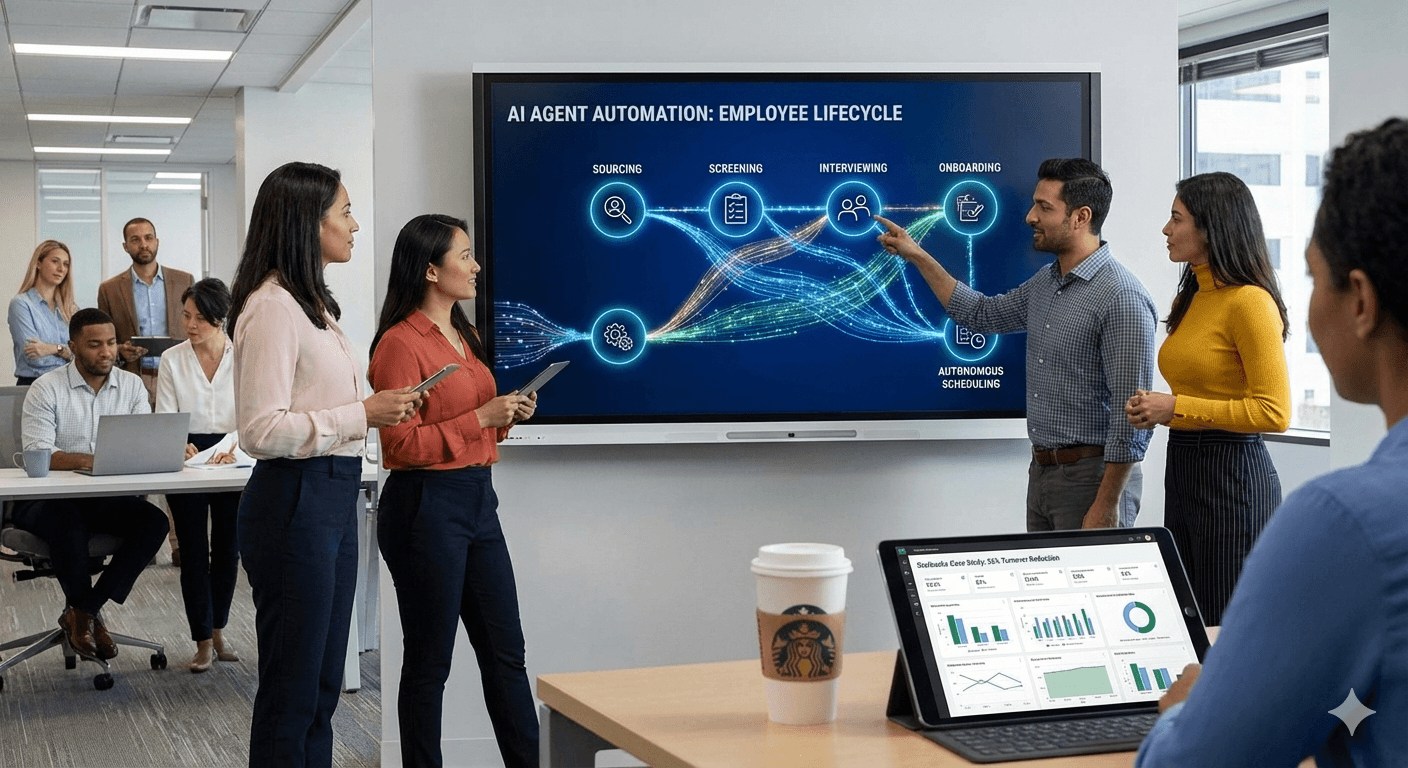
In 2026, the global labor market has moved beyond the "Chatbot era." Organizations are no longer just using AI to answer FAQs; they are deploying Autonomous AI Agents that execute end-to-end workflows—from sourcing talent to verifying visas and orchestrating onboarding.
For industries with high turnover, the "vacant shift" is a direct hit to the bottom line. Traditional recruitment is too slow for the "on-demand" expectations of the 2026 workforce. This guide outlines how to build an Agentic HR Strategy that prioritizes speed, quality, and human-centric connection.
The 2026 Pivot: From Co-pilots to Autonomous Agents
The fundamental shift this year is the rise of Agentic AI. Unlike a co-pilot that waits for a prompt, an HR Agent understands a goal (e.g., "Fill 10 Barista roles by Monday") and independently coordinates the steps to achieve it.
1. The Sourcing & Engagement Agent
In high-volume hiring, speed is the primary filter.
The Action: As soon as a candidate applies via SMS, WhatsApp, or social media, the agent engages instantly.
Strategic Impact: Application completion rates have jumped from 50% to over 85% in firms using mobile-first agents, as candidates no longer feel "ghosted" by slow human response times.
2. The Contextual Screening Agent
By late 2026, nearly 90% of candidates use AI to write their resumes, making traditional CV filtering obsolete.
The Strategy: Agents now use "Chat Interviews"—short, situational assessments that analyze language patterns for soft skills like empathy and resilience.
The Goal: Finding "Signal in the Noise" by evaluating how a candidate thinks, not just what they've written.
Real-World Case Study: Starbucks Australia
Starbucks provides a masterclass in using AI to humanize a brand at scale. By 2025, their Australian operations faced a "Resume Mountain" that consumed over 1,900 hours of manual screening monthly.
The Implementation
Starbucks integrated a specialized library of agents (including Sapia.ai and CheckWorkRights) into their existing tech stack.
Automated Shortlisting: Instead of reading CVs, managers received a "Top Tier" shortlist based on chat interviews that measured "cultural connection."
Compliance on Autopilot: An agent autonomously verified work visas and background checks, a critical task for a diverse, visa-dependent workforce.
The Strategic Results
Metric | Impact |
Early Turnover | 56% decrease in barista churn within the first 90 days. |
Time Reclaimed | 1,900 hours saved per month for store managers. |
Hiring Velocity | Reduced from 10+ days to under 24 hours in key locations. |
Candidate Experience | Achieved a 9.1/10 satisfaction score across 35,000+ applicants. |
"I prefer my teams actually talking to people instead of doing admin. AI is a tool that allows us to focus on the 'important stuff' like onboarding and culture."
— Rod Roberts, Talent Manager, Starbucks
The 2026 Compliance Mandate: The EU AI Act & Global Ethics
As of August 2, 2026, the EU AI Act classifies AI systems used in recruitment and worker management as "High-Risk." This sets a global precedent for implementation leaders.
Algorithmic Transparency: You must be able to explain why an agent ranked a candidate a certain way. "Black box" hiring is now a legal liability.
Bias Auditing: Monthly audits are required to ensure agents aren't inadvertently discriminating based on gender, age, or ethnicity.
Human-in-the-Loop: While agents handle 90% of the funnel, the Final Hiring Decision must remain human. The agent is the "Administrative Coordinator," but the manager is the "Culture Gatekeeper."
Implementation Roadmap: Building Your HR Agent Library
To achieve the "Starbucks Effect," leaders should deploy agents in a phased approach:
Agent Type | Responsibility | Key ROI Metric |
The "Logistics" Agent | Self-schedules interviews into manager calendars; sends reminders. | Zero interview ghosting; 4 hours saved/week/manager. |
The "Quality" Agent | Conducts behavioral chat interviews; predicts long-term retention. | 20% increase in "Top Performer" hires. |
The "Warm-Up" Agent | Nudges new hires with culture videos and paperwork before Day One. | 40% reduction in "Day One No-Shows." |
Frequently Asked Questions (FAQ)
Q: Won't candidates feel alienated by an AI-led process?
Data shows the opposite. In 2026, the most frustrating experience for a candidate is silence. Candidates prefer an instant, 24/7 interaction with a respectful AI over a "black hole" application that never receives a response.
Q: How do we prevent the AI from being fooled by "AI-generated" applications?
Since agents move candidates quickly into live chat interviews or video scenarios, "polish" matters less than "presence." Agents are trained to detect inconsistencies between a perfect resume and a real-time behavioral response.
Q: What is the primary risk of autonomous HR agents?
The biggest risk is integration failure. For an agent to be truly autonomous, it must have read/write access to your ATS (Applicant Tracking System) and store managers' live calendars. Without deep integration, it remains a disconnected chatbot.
¿Por qué elegirnos?
Creado por innovadores
Descubra cómo nuestras estrategias innovadoras, enfoque basado en datos y compromiso con los resultados nos distinguen de la competencia
Trabajo Manual
Entrega lenta y ciclos de desarrollo largos
Limitado por las horas de trabajo
Altos costos laborales y generales
Difícil de adaptar, costoso de escalar
Trabajo Desconectado y Repetitivo
Quedarse atrás de los competidores
Método Groath
Decisiones inteligentes impulsadas por IA
Flujos de trabajo automatizados 24/7
Escalable y Rentable
Procesamiento de Datos Instantáneo
Integración de Sistemas Sin Problemas
Producción consistente y confiable
Nuestro Proceso
Nuestro proceso simple, inteligente y escalable
Diseñamos y construimos sistemas inteligentes usando un proceso claro, rápido e iterativo que funciona para startups y equipos establecidos.
Paso 1
Análisis Estratégico
Analizamos su producto, flujos de trabajo o idea para descubrir dónde los agentes de IA, la automatización o el desarrollo personalizado generarán el mayor impacto.
Analizando el flujo de trabajo actual.
Verificación del sistema
Verificación de proceso
Verificación de velocidad
Trabajo manual
Tarea repetitiva
Paso 2
Desarrollo de IA
Nuestro equipo experto diseña y construye la lógica central, los modelos y las automatizaciones detrás de tus agentes de IA o aplicación personalizada.
Paso 3
Integración sin problemas
Integramos tu nueva aplicación o agentes de IA en tus herramientas y flujos de trabajo existentes, asegurando que todo funcione sin problemas con mínima interrupción.
Nuestra solución
Tu pila
Paso 4
Optimización continua
Ofrecemos optimización continua, mejorando su software y agentes con nuevas mejoras, mayor precisión y automatizaciones más inteligentes.
Sistema de chatbot
La eficiencia aumentará un 20%
Sistema de flujo de trabajo
Actualización disponible.
Sistema de ventas
Actualizado
Preguntas frecuentes
Tenemos las respuestas que buscas
Respuestas rápidas a sus preguntas sobre automatización con IA.
¿Qué puede construir realmente Groath?
¿Cómo sé qué construir o automatizar primero?
¿Necesito experiencia técnica para trabajar con Groath?
¿Puede cualquier negocio usar IA?
¿Qué tipo de soporte ofrecen?
Lidera el camino utilizando IA en tu flujo de trabajo
Reserva una llamada hoy y comienza a automatizar