Badge
AI Customer Service Agent | Automate Resolution & Personalize Support
Revolutionize support with AI Customer Service Agents. Achieve 24/7 availability, instant resolution of 60%+ of queries, and personalize every customer interaction.
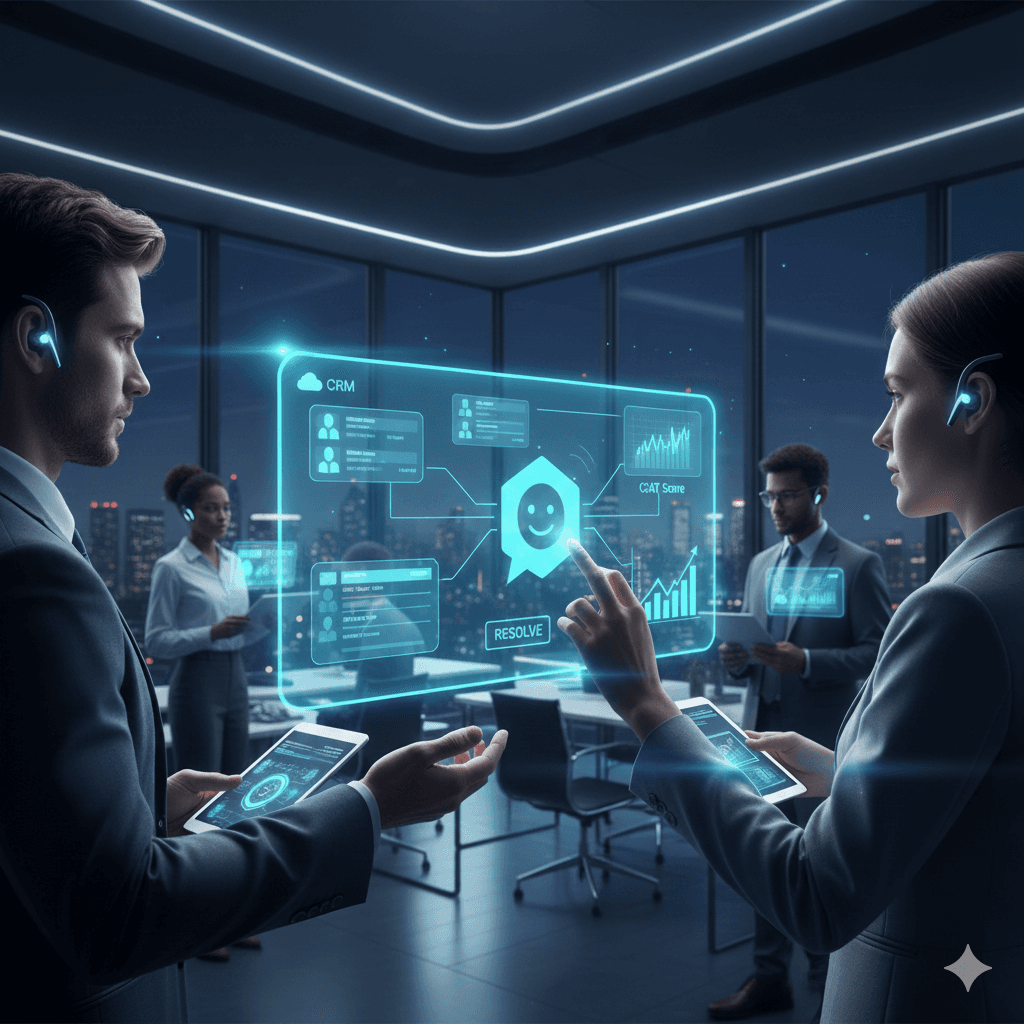
Customer support is the lifeblood of customer retention, yet it remains one of the most expensive and least scalable parts of the modern business. Companies are often trapped in a cycle of high call volumes, long wait times, and high agent turnover, leading to poor customer experience (CX) and escalating costs.
The AI Customer Service Agent moves far beyond basic chatbots. It operates as an Intelligent Support Orchestrator—an autonomous employee capable of understanding complex, multi-step issues, accessing multiple internal systems (CRM, ERP, ticketing), and resolving customer problems end-to-end without human intervention.
The Challenge of Scaling High-Quality Customer Support
For large enterprises, delivering consistently high-quality support 24/7 is a significant operational drain:
High Operational Cost: Staffing 24/7 human support teams, especially for global operations, is prohibitively expensive, driving up the cost-per-contact.
Service Inconsistency: Human agents, while empathetic, are subject to fatigue and variation in training, leading to inconsistent quality and resolution times.
Complexity & Escalation: Traditional chatbots fail on any query that requires accessing a back-end system (like checking an order status or processing a return), forcing unnecessary escalation to human agents.
Agent Burnout: Human agents are overwhelmed by repetitive Tier 1 queries (e.g., "What is my order status?," "How do I reset my password?"), leading to high turnover and poor morale.
The AI Agent Solution: Autonomous, Context-Aware Support
The AI Customer Service Agent is built on advanced Generative AI and Agentic Architecture to deliver personalized, autonomous resolution.
How it Works: The 5-Step Agent Workflow
Contextual Intake: The agent engages the customer (via chat, voice, or email) and immediately integrates all available CRM data, including purchase history, prior tickets, and customer sentiment, to understand the full context of the interaction.
Intent and Sentiment Analysis: Using Natural Language Understanding (NLU), the agent not only deciphers the customer's request but also assesses their emotional state, adjusting its tone and urgency accordingly.
Multi-System Action: The core strength: the agent is empowered to use internal tools. It executes multi-step tasks by integrating with systems like the ERP (for order tracking), Inventory Management, and Billing (for refunds).
Autonomous Resolution: The agent resolves 60-80% of common L1/L2 inquiries (e.g., processes a return, updates an address, schedules a technician, or applies a refund) autonomously, without involving a human.
Seamless Hand-off: If the issue is novel, high-value, or requires deep empathy, the agent generates a concise summary of the entire interaction, assigns a priority level, and seamlessly transfers the customer and the full context to the most qualified human agent.
Key Benefits: Driving CX and Cost Reduction
Implementing the AI Customer Service Agent delivers immediate, measurable impact across the business:
Massive Cost Reduction: Companies typically see a 40-70% reduction in labor costs for handling Tier 1 support volume, often resolving the equivalent workload of hundreds of human agents.
24/7 Global Availability: Provides instant, multilingual support across all time zones, ensuring a consistently excellent experience regardless of where the customer is located.
Faster Resolution Times (MTTR): Autonomous resolution drops the Mean Time To Resolution from hours to seconds for common issues, boosting customer satisfaction scores (CSAT).
Proactive Service: The agent can monitor systems and customer behavior (e.g., a customer viewing a help page multiple times) and initiate contact proactively, often solving a problem before the customer formally reports it.
Deployment & Customization Options
The agent's power lies in its ability to deploy consistently across virtually every channel a customer uses:
Website Widget/Chatbot: Handling L1 inquiries on the main website.
Voice/IVR: Providing natural, conversational support over the phone, eliminating frustrating menu systems.
Email & Ticketing Triage: Reading inbound emails, automatically classifying tickets, and initiating autonomous resolution flows before a human sees the ticket.
Social Media & Messaging: Monitoring channels (WhatsApp, Facebook Messenger, X) for support requests and engaging instantly.
AI Customer Service Agent: Feature Comparison
This table highlights the difference in capability between a modern AI Agent and older automation tools.
Feature / Aspect | AI Customer Service Agent | Traditional Chatbot (FAQ Bot) | Human Support Agent |
Data Access & Action | Autonomous (Reads & writes to CRM/ERP) | None (Static answers only) | Manual (Requires human effort) |
Issue Complexity | L2 Resolution (Multi-step, transactional) | L1 Resolution (FAQ only) | L3 Resolution (Novel, emotional, strategic) |
Scalability | Unlimited concurrent users, 24/7 | High (for simple questions) | Limited by headcount and working hours |
Error Rate | Low (Logic-driven system integration) | Moderate (Frustrates users when failing) | Variable (Subject to fatigue/training) |
Learning | Continuous (Learns from every interaction) | None (Requires manual rule updates) | Through training and experience |
Frequently Asked Questions (FAQ)
Q: What is the risk of the agent getting a customer's personal data wrong?
The risk is low, provided the agent is integrated correctly. The agent is not guessing; it is reading directly from your authoritative internal systems (CRM, ERP). The process must be built on strict API security protocols and Zero Trust principles to ensure it only accesses and modifies data it is explicitly authorized to touch.
Q: Does this type of agent compromise the human touch in customer support?
Paradoxically, it often improves the human touch. By automating the low-value, repetitive tasks, the agent filters and enriches the tickets that truly need human attention. When a customer is escalated, the human agent receives a fully contextualized case summary, allowing them to skip the basic questions and focus immediately on empathetic, high-value problem-solving.
Q: How long does it take to deploy an agent capable of L2 resolution?
Deployment time varies by the complexity of the back-end integrations. A basic, FAQ-driven agent can be live in weeks. An L2 agent that must securely integrate with three or more systems (e.g., CRM, Order Database, and Returns System) typically requires 2-4 months of planning, integration, and training to ensure reliability and security.
Why now
Build like its 2050
You either use AI, or it uses you.
Manual Work
Long development cycles
Limited by Work Hours
High Labor Costs & Overhead
Hard to adapt, expensive to scale
Disconnected & Repetitive Work
Falling behind competitors
Build with AI
Smart, AI-Driven Decisions
24/7 Automated Workflows
Scalable & Cost-Effective
Instant Data Processing
Seamless System Integration
Consistent & Reliable Output
Our Process
Our Simple, Smart, and Scalable Process
We design and build intelligent systems using a clear, fast, and iterative process that works for startups and established teams.
Step 1
Strategic Analysis
We analyze your product, workflows, or idea to uncover where AI agents, automation, or custom development will create the highest impact.
Analyzing current workflow..
System check
Process check
Speed check
Manual work
Repetative task
Step 2
AI Development
Our expert team designs and builds the core logic, models, and automations behind your AI agents or custom app.
Step 3
Seamless Integration
We integrate your new app or AI agents into your existing tools and workflows, ensuring everything works smoothly with minimal disruption.
Our solution
Your stack
Step 4
Continuous Optimization
We provide ongoing optimization, refining your software and agents with new improvements, better accuracy, and smarter automations.
Chatbot system
Efficiency will increase by 20%
Workflow system
Update available..
Sales system
Up to date
FAQs
We’ve Got the Answers You’re Looking For
Quick answers to your AI automation questions.
What can Groath actually build?
How do I know what to build or automate first?
Do I need technical experience to work with Groath?
Can any business use AI?
What kind of support do you offer?
Lead The Way By Using AI In Your Workflow
Book a Call Today and Start Automating