Industry Deep Dives·May 25, 2026
AI Marketing for Law Firms: Lead Capture, Intake, and the 4-Hour Response Rule
AI marketing for law firms is intake, not ads. The 3 pillars (capture, qualify, route), Bar-compliant guardrails, and the response-time math that wins matters.
The average law firm takes more than 24 hours to respond to a website lead. By the time the partner gets the notification, the prospect has already filled out forms on three other firms' sites and signed an engagement letter with the one that called back inside an hour. AI marketing for law firms is not about generating clever ad copy — it is about closing that response-time gap, every weekend, every holiday, every after-hours call, without putting a non-lawyer in the position of giving legal advice.
That last clause is the constraint most marketing vendors miss. The Bar advertising rules in every U.S. state limit what an intake script can say, what disclaimers must appear, and what conflict checks must happen before a lawyer-client relationship is even discussed. According to the American Bar Association's 2025 TechReport, fewer than one in five firms run any kind of automated after-hours intake — yet the firms that do consistently report higher lead-to-matter conversion than peers, because every state Bar's rules permit a non-lawyer intake assistant (human or AI) to collect information, schedule, and route, as long as the boundary against legal advice is enforced. AI makes that boundary easier to enforce, not harder.
The 4-hour response rule is generous — the real benchmark is 5 minutes
The 4-hour figure gets repeated in legal marketing decks because it is forgiving enough that most firms can imagine meeting it. The data is less kind. Harvard Business Review's research on lead-response timing found that firms responding within five minutes were roughly 100× more likely to make contact than those waiting half an hour, and seven times more likely to have a qualifying conversation than those waiting an hour. For legal services, where the prospect is often in distress and shopping urgency is at its peak, the response curve is steeper than the cross-industry average — not gentler.
What the 4-hour rule does correctly is set the floor below which a firm is structurally non-competitive. If a workers' comp claimant fills out a contact form at 9 p.m. Tuesday and the firm responds at noon Wednesday, the matter is gone before the response lands. The decision tree for a firm is not whether to staff after-hours intake — competitors have already decided that for them — but how to staff it at a cost that does not erase the matter's economics.
- Option A — outsourced human call center. Common, expensive, and structurally limited. Per-lead pricing runs $25–$75 for the qualifying call, and the staff are not lawyers, so the script is rigid by Bar-rules necessity. Quality is uneven and weekend coverage is the first thing to slip.
- Option B — internal after-hours rotation. Adds $60K–$120K per junior associate to cover the gap, and the work is universally hated. Turnover is high; the rotation eats the time of the same people you want billing.
- Option C — AI intake with human escalation. An AI agent handles the first qualifying turn 24/7, captures the matter facts, checks for obvious conflicts, books the consultation, and escalates to a human only when the prospect signals urgency or asks something the agent has been scoped to decline. Marginal cost per lead approaches zero after the build.
The response-time benchmark for legal intake is minutes, not hours — and only the AI-plus-escalation pattern hits the benchmark at a cost structure the matter can absorb.
The 3 pillars: capture, qualify, route
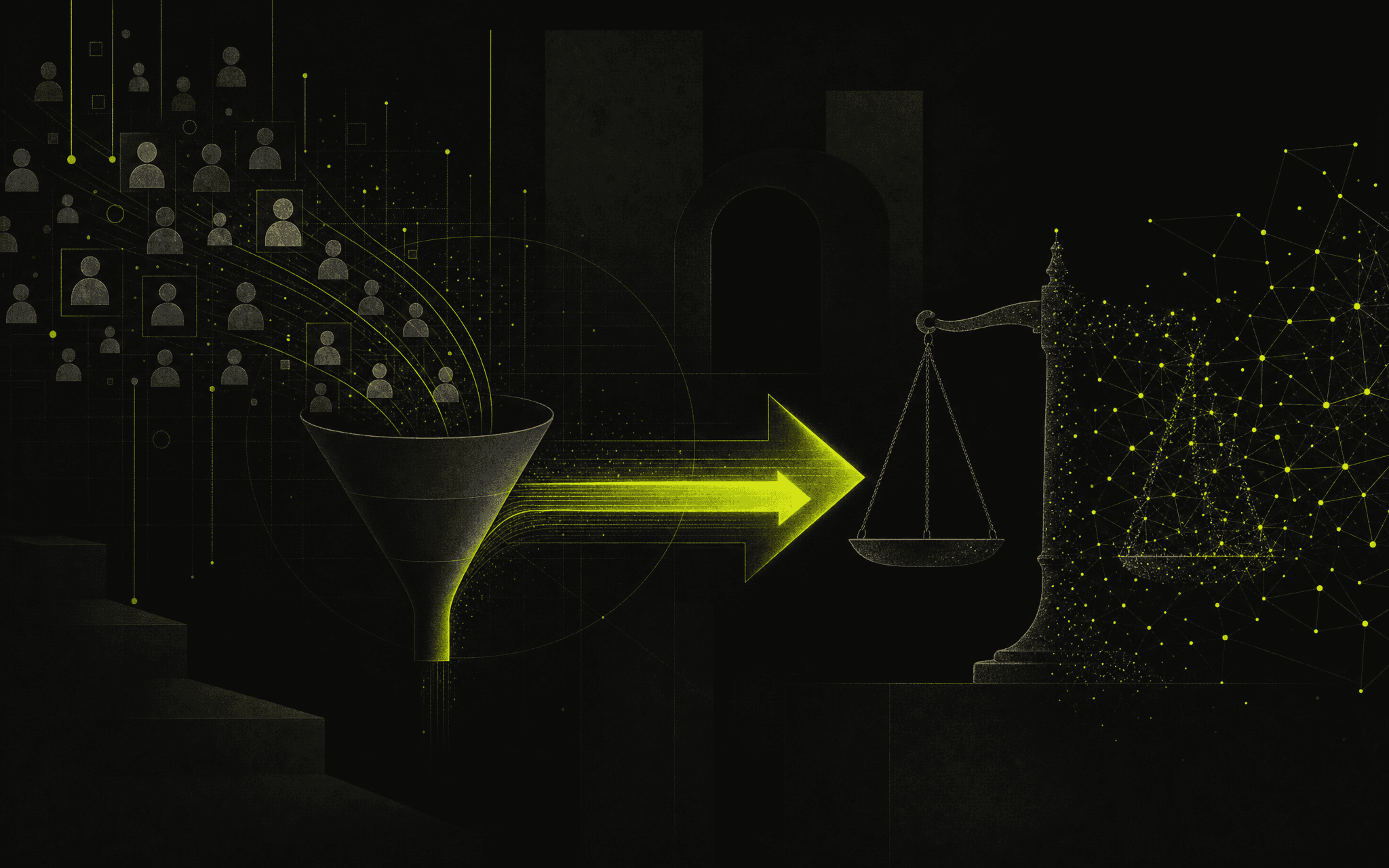
Most firms treat "AI marketing" as a synonym for "AI-generated blog posts." Useful, but it is the tail wagging the dog. The marketing flywheel for a law firm is the intake funnel, and it has three sequential pillars where AI replaces failing manual work.
- 1. Capture. The website form that does not just collect a name and a sentence of free text, but asks the right three follow-up questions based on practice area. A personal-injury form should branch on "were emergency services called" and "have you spoken to an insurer." A family-law form should branch on jurisdiction and whether papers have been filed. An AI-driven form short-circuits the back-and-forth that traditionally takes three calls to resolve.
- 2. Qualify. The intake assistant — text on the site, voice on the phone, or both — that runs the matter facts against the firm's intake criteria. Statute of limitations checks, jurisdiction match, fee structure fit, basic conflict screen against the firm's matter database. The output is a structured intake record, not a transcript a paralegal has to re-type Monday morning.
- 3. Route. The matter goes to the right attorney based on practice area, language, and availability — and into the right matter-management system with the right disclaimers already attached. The follow-up call is booked in the lawyer's calendar before the prospect closes the laptop.
Each pillar replaces a real failure mode. Capture replaces the lead that filled out three lines and bounced before staff could call back. Qualify replaces the 20-minute intake call that ends with "we don't actually take cases in your county." Route replaces the matter that sat in someone's inbox for two business days because the partner who normally handles slip-and-fall was in trial. Our deeper read on AI for law firms across document review, research, and billing covers the back-office side of the same shift; the marketing-intake side is where the new revenue actually enters the building.
The non-obvious leverage. Most firms over-invest in capture (a slick website) and under-invest in qualify and route (the boring middle). The conversion math is the inverse of the spend: improving qualification accuracy by 20% moves more matters than doubling website traffic, because every unqualified lead routed to a lawyer burns the same intake time as a qualified one.
Build the funnel in order — capture, then qualify, then route — and treat the middle pillar as the highest-leverage spend even when the website looks like it should be the priority.
Bar compliance — what the AI cannot do, and why that is fine
The objection that lands in every partner meeting on this topic is some variant of: "isn't this practicing law without a license?" It is a fair instinct, and the answer determines whether the deployment ships or dies in committee. The short version is that the AI is not practicing law — it is doing the same work a paralegal or call-center intake assistant has been doing for decades, under the same constraints, with the same disclaimers.
The AI intake assistant is not your firm's newest lawyer. It is your firm's tireless paralegal — and the same Bar rules that have governed paralegal intake for thirty years are the ones that govern it now.
The constraints are real and they need to be encoded in the agent's prompt, not left to the model's judgment. Three guardrails matter most:
- No legal advice, no legal opinions. The agent collects facts and answers process questions ("how long does a divorce take in this state?" — generic, OK; "do I have a case?" — escalate or decline). State Bar advertising rules vary, but every state prohibits a non-lawyer from giving case-specific legal advice. Encode the line.
- Disclaimer up front and on every transcript. The agent must identify itself as a non-lawyer intake assistant, not a lawyer, and explain that no attorney-client relationship is formed by the conversation. The disclaimer must persist in the transcript that gets logged.
- Conflict check before substantive discussion. The agent collects names, opposing parties, and adverse witnesses and runs them against the firm's conflict database before the intake is allowed to deepen. A scheduled consultation against an undeclared conflict is malpractice exposure no marketing automation should create.
The Clio Legal Trends Report has tracked the slow climb of tech adoption in firms, and the pattern in 2025 was clear: firms that deployed AI intake under tight guardrails grew matter volume faster than peers with the same marketing spend, while firms that deployed without the guardrails ended up in their state Bar's ethics opinion footnotes. The technology is permitted. The implementation discipline is what separates the two outcomes.
Treat the AI intake agent as a regulated paralegal — encode the three guardrails (no advice, persistent disclaimer, conflict check) in the prompt before the agent ever speaks to a prospect.
The stack — what to buy, what to build, what to skip
The 2026 stack for a mid-market firm (10–80 lawyers) has three layers, and there is one common mistake at each layer that doubles the cost without doubling the result.
- Layer 1 — web capture. The form on the firm's site. Off-the-shelf options like Lawmatics, Captorra, or Clio Grow handle the basics. Skip the bespoke build here — the marginal value over a configured Lawmatics form is rounding error compared to the value of getting the qualification right downstream.
- Layer 2 — qualifying intake (text + voice). This is where the build-vs-buy line moves. SaaS-only chatbots that won't be retrained on the firm's practice areas are too generic; they qualify on industry templates and miss firm-specific criteria. A custom intake agent — trained on the firm's actual matter types, fee structure, and conflict database — typically lands in the $15K–$60K build range with $2K–$8K per month to operate. Pair it with a voice handoff for the calls that need to escalate. Our piece on voice agents in production covers the handoff design.
- Layer 3 — routing & CRM. Clio, MyCase, or PracticePanther on the matter side; a thin integration layer pushes qualified intakes in with the right attorney, the right disclaimers, and the right next-action. Don't replace the practice-management system — integrate with it.
The mistake to avoid at every layer is buying a turnkey "AI legal marketing" SaaS that promises to do all three and instead does one mediocrely. Layer 1 is a commodity. Layer 2 is the differentiator and needs custom training. Layer 3 is integration work, not product work. Treating them as one purchase is how firms end up with a chatbot that greets prospects, fails to qualify them, and dumps the transcript in a folder no one reads. If you're sizing the right partner for the layer-2 build, our checklist on how to choose an AI implementation partner is the right next read — same buyer questions, framed for legal-services constraints.
For the funnel itself, lean on the same automation infrastructure that powers AI support deployments for after-hours coverage and the sales lead automation patterns that have already been productionized in adjacent verticals — the underlying agent architecture is the same, only the prompts, guardrails, and integrations change. Firms that have already shipped on the back-office side (see our billing recovery deep-dive) can usually reuse the data layer and security review for the intake build, cutting the second project's timeline in half.
Buy layer 1, build layer 2, integrate layer 3 — and refuse any vendor pitching a single SKU that bundles all three, because the bundled version always underdelivers the middle.
What to do next
AI marketing for law firms is the intake funnel, not the ad budget. The firms winning new matters in 2026 are the ones whose forms qualify in real time, whose after-hours leads talk to a Bar-compliant intake agent inside five minutes, and whose routing puts the right matter in front of the right partner before the prospect has closed their browser. The technology is permitted, the math is in the firm's favor, and the operating cost is small enough that even a 10-lawyer firm can justify the build off a single recovered matter.
The right diagnostic is to look at the last 90 days of website leads, count how many got a response in under an hour, and compare that number to total form submissions. If the ratio is under 50%, the firm is leaking matters that could be funding the entire marketing build twice over. For an end-to-end view of where AI fits across the firm — not just intake — start with our deeper read on AI in the legal industry, then map the intake build against the practice areas where the response-time gap is widest.
Audit the last 90 days of leads, find the response-time gap, and let the size of that gap — not a vendor's pitch deck — set the budget for the intake build.